
Vaginal tightening after childbirth is something we get asked about more often than most women would guess, usually quietly, at the end of an appointment booked for another reason. If you feel things have changed since your delivery, you are not imagining it, and you have more options than the adverts suggest.
This guide covers why vaginal laxity happens, how long to wait, and where each option fits, including what it cannot do. If bladder leakage bothers you more, begin with our guide to urinary incontinence after childbirth, because the plan there is different.
Vaginal tightening after childbirth: the short answer
Give your body several months to recover, then start with pelvic floor training. If a feeling of looseness remains, a doctor can examine you and discuss HIFU or Endolift laser for milder laxity, or surgical repair when the tissue is clearly stretched. The evidence for energy devices is still limited and none of them treats prolapse, so a bulge or pressure needs a medical review first.
Why vaginal laxity happens after birth
The vagina is built to stretch. During a natural delivery its walls widen to let the baby through, and the pelvic floor, the sling of muscle that holds up the bladder, womb and bowel, stretches with them. Much of this recovers by itself, though some women are left with a lasting sense of looseness.
Several things affect how much change stays:
- Number of deliveries: each birth adds to the load on the same tissue.
- A difficult birth: a long labour, a large baby or a tear can leave more stretching behind.
- Age: collagen and muscle tone fall gradually over the years.
- Hormones: oestrogen keeps the tissue thick and moist, and it drops after delivery and around menopause.
- Breastfeeding: oestrogen tends to stay low while you nurse, so dryness is common during these months, and it often eases with time.
How long to wait before any vaginal tightening treatment
We ask you to allow several months after delivery before any vaginal tightening procedure. Early on the tissue is still healing and the muscles are slowly regaining strength, so nobody can judge yet what will remain.
There is no single date that suits everyone. A woman whose tear healed slowly may need longer than a friend who delivered the same week. Your doctor decides the timing after examining you. Tell us if you are planning another baby, because none of these procedures is done during pregnancy.
Natural birth or Caesarean: does it change anything?
Women who had a Caesarean often ask whether vaginal tightening applies to them. The baby did not pass through the birth canal, so stretching of the vaginal walls is usually less of a factor. Pregnancy still puts months of extra weight on the pelvic floor, though, so weakness can follow a Caesarean too.
After a natural birth the changes tend to be more direct, especially after several deliveries. Either way, we plan from what the examination shows now.

Start with pelvic floor training
This is the first-line step before any vaginal tightening procedure, and it helps even if you later choose one. You squeeze and lift the muscles you would use to hold back urine, hold briefly, let go fully, then repeat several times a day. You can do this while feeding the baby, and nobody will know.
Technique is where many women slip. Holding your breath, tightening your tummy or pushing down all work against you, so ask a physiotherapist trained in women’s health to check you if you are unsure. Give it a few months before you judge it.
Creams, gels, herbal mixtures and similar tightening products are not proven, so we do not recommend them.
Vaginal tightening without surgery: HIFU, laser and the Tesla Chair
Vaginal tightening without surgery is usually discussed for mild to moderate laxity, after exercises, when there is no prolapse. These options sit within our feminine aesthetics service, and they work in different ways.
HIFU vaginal tightening
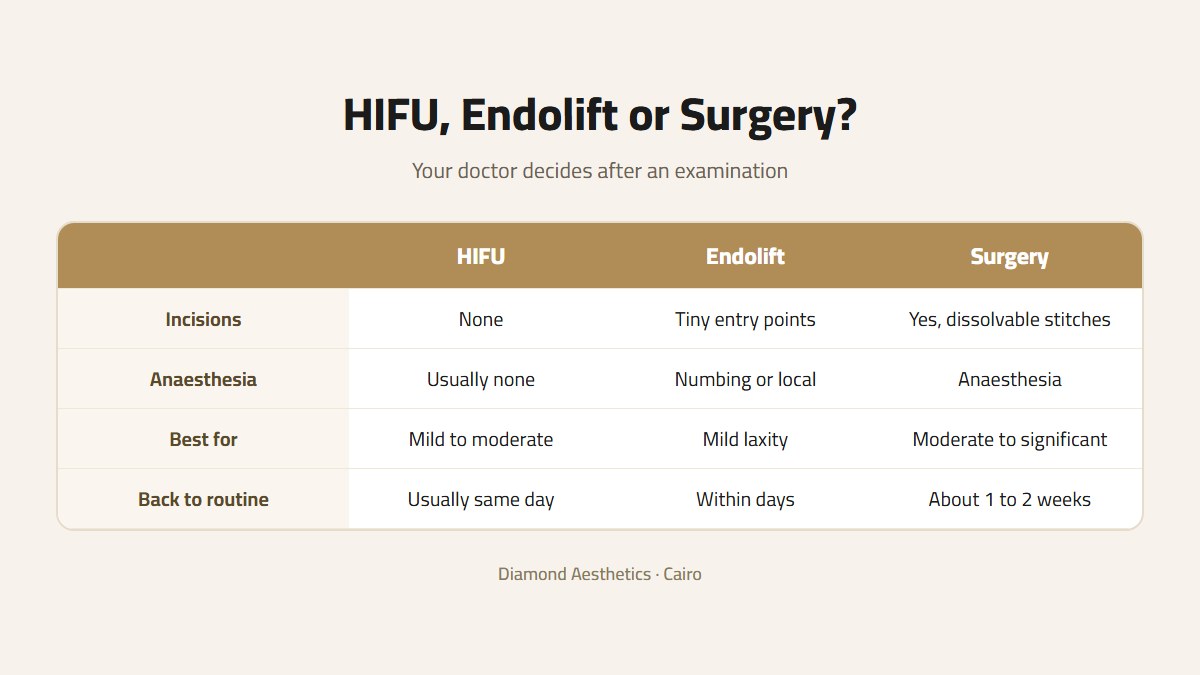
HIFU sends focused ultrasound into the deeper tissue with the aim of stimulating new collagen. The doctor uses a slim probe in short passes, and most women describe warmth more than pain. You go home the same day, and any improvement builds slowly over the following weeks. Our comparison of how Endolift laser and HIFU differ explains the technology.
Laser vaginal tightening with Endolift
Laser vaginal tightening with Endolift uses a very fine fibre to deliver controlled heat, aiming to tighten the tissue and renew collagen. It is done in the clinic with numbing cream or local anaesthetic, and it may suit mild laxity or dryness linked to hormonal change. Read more about how the Endolift laser works.
Tesla Chair
The Tesla Chair works on muscle. Electromagnetic stimulation makes the pelvic floor contract strongly while you sit fully clothed, over several sessions across a few weeks. It suits women who struggle to do the exercises correctly. Our page on M-Shape electromagnetic muscle stimulation explains the same principle. It will not repair stretched tissue.
PRP as an add-on
PRP is prepared from your own blood and injected after numbing, sometimes alongside HIFU or Endolift to help with dryness. Research here is still developing, so think of it as a possible extra. Our guide to regenerative aesthetic treatments gives the background.
Vaginal tightening surgery: when repair makes sense
Vaginal tightening surgery, often called vaginoplasty or perineoplasty, repairs stretched tissue and brings the supporting muscles closer together. It is generally considered when laxity is moderate to significant and non-surgical treatment is unlikely to be enough.
You will have an examination and routine tests first. The operation is done under anaesthesia, typically with dissolvable stitches. If you may want more children, say so early, because another delivery can stretch the repair again. Our article on whether plastic surgery in Egypt is safe can help you judge any facility and team.
How to choose a vaginal tightening treatment
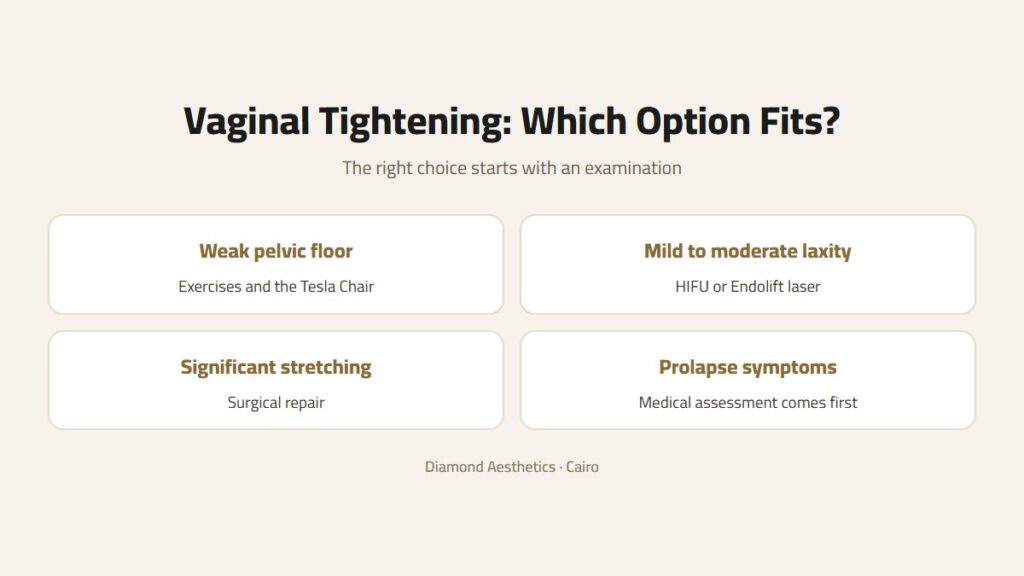
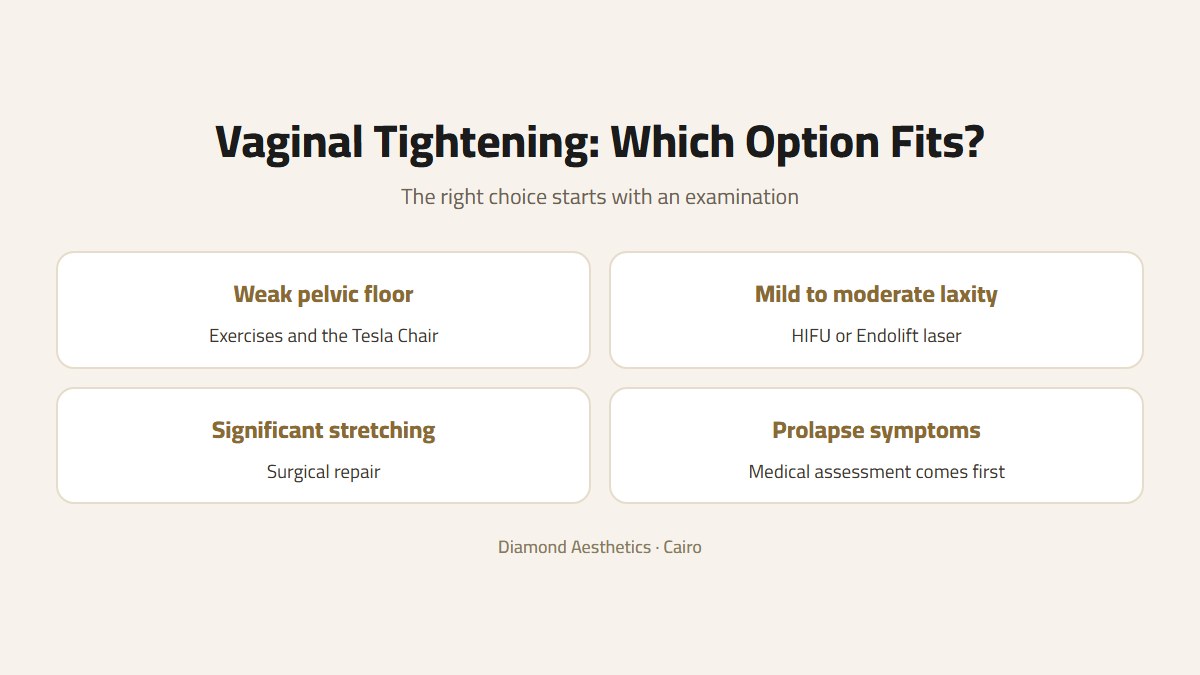
We start from what the examination shows, then match the option to it:
- If you delivered recently or never trained properly, start with exercises and wait.
- If your muscles feel weak or the exercises are hard to get right, consider the Tesla Chair alongside them.
- If laxity is mild to moderate, there is no prolapse and you prefer no incisions, ask about HIFU or Endolift laser.
- If the stretching is significant, surgery is more likely to help.
- If you feel a bulge or pressure, see a gynaecologist before anything else.
Some women also find that what really bothers them is the abdomen, which no pelvic treatment reaches. That is a separate conversation about what a tummy tuck can repair.
Recovery after each option
Recovery depends on the route you take, and your doctor will adjust this pattern for you:
| Option | Back to routine | Exercise and intimacy |
|---|---|---|
| HIFU | Usually the same day | Intimacy may be paused for a few days |
| Endolift laser | Within days | As your doctor advises |
| Tesla Chair | Straight after the session | As your doctor advises |
| Surgery | Light work in about a week or two | Usually postponed for around six to eight weeks |
After surgery, most women need a few days of proper rest. Arrange help with lifting small children, since a toddler who wants carrying is hard to refuse.
Risks, evidence and realistic results
Vaginal tightening surgery carries the risks of any operation: bleeding, infection, discomfort, scarring and changes in sensation. Energy devices usually cause only swelling or sensitivity, though burns, scarring and lasting pain have been reported.
The evidence for energy-based vaginal tightening is still developing. Health regulators, including the US FDA, have cautioned against marketing that makes unproven claims for these devices, so be wary of any guaranteed result. Our wider look at whether non-surgical treatments really work shows how we weigh such claims.

A realistic result is a gradual sense of more support and comfort. It will not take you back to exactly how you were before pregnancy, and non-surgical results may fade. Plans here are supervised by Dr Sherif Hegazy, a member of ISHRS, ASPS and IAAM with more than 10,000 procedures behind him.
Warning signs that need a medical review
Laxity alone is not dangerous, but these symptoms should not wait:
- A bulge, or a feeling that something is coming down inside the vagina.
- Pressure or heaviness in the pelvis, especially by the end of the day.
- Bleeding you did not expect, after your bleeding from delivery has stopped.
- Pain that does not settle.
- Trouble passing urine or emptying your bowels.
A bulge or pressure can mean prolapse, where pelvic organs drop towards the vagina. Vaginal tightening devices do not treat it, and a gynaecologist needs to assess it. The American College of Obstetricians and Gynecologists has a clear patient guide to pelvic support problems.
Vaginal tightening in short: allow several months after birth, train your pelvic floor first, and get examined before choosing. Devices may help milder laxity, surgery suits significant stretching, and prolapse symptoms need medical review before anything cosmetic.
FAQ
Questions women ask us about vaginal tightening
Can I have vaginal tightening without surgery?
Yes, if laxity is mild to moderate and there is no prolapse. Pelvic floor training comes first, and HIFU, Endolift laser or the Tesla Chair may be discussed after an examination.
How soon after giving birth can I have a vaginal tightening treatment?
Allow several months so the tissue can heal and the muscles can recover. There is no fixed date, and your doctor decides after examining you.
Do I need vaginal tightening after a Caesarean?
Often not. Pregnancy can still weaken the pelvic floor after a Caesarean, so pelvic floor training is the usual first step, and an examination shows whether anything more is worthwhile.
Does laser vaginal tightening hurt?
Most women describe warmth more than pain, and numbing cream or local anaesthetic is usually used. Mild swelling or sensitivity for a few days is common.
Is vaginal tightening surgery better than laser or HIFU?
It depends on the degree of laxity. Surgery repairs tissue directly and suits moderate to significant stretching, while devices are for milder cases and have less evidence behind them.
Can vaginal laxity improve by itself?
Often it does improve over the first months after delivery, especially with regular pelvic floor training. Dryness linked to breastfeeding may also ease with time.
Talk to our team about vaginal tightening
Whatever you decide about vaginal tightening, the first step is the same: a private conversation and an examination, with no pressure to book anything. You can see every option we offer on our feminine aesthetics page.
When you feel ready, contact our clinic in Cairo to arrange a confidential consultation, and bring your questions with you, however awkward they feel.