
The endolift vs HIFU question gets asked in almost every non-surgical lifting consultation. Both technologies claim to lift skin without surgery. Both have legitimate clinical backing. The marketing makes them sound interchangeable, but they aren’t — they operate on different layers, treat different severity of laxity, and have very different downtime profiles. Picking the wrong one usually means treating mild laxity with an aggressive tool, or treating moderate laxity with a tool that physically can’t reach the problem.
The honest comparison comes down to one variable: how loose is the skin, actually.
Endolift vs HIFU at a Glance
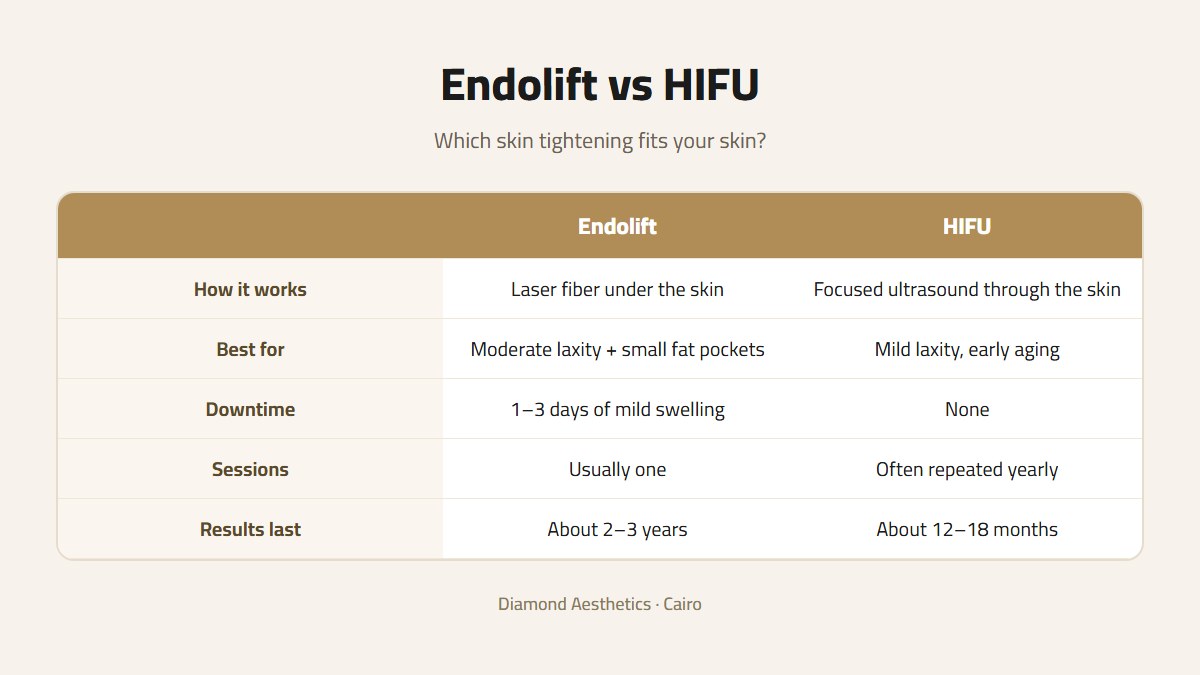
In short: HIFU suits mild laxity and people who want zero downtime; Endolift suits moderate laxity — especially with small fat pockets under the chin or along the jawline — in exchange for one to three days of mild swelling.
The Difference, Plainly
- Endolift is a minimally invasive laser treatment delivered through tiny entry points using a 1470nm fiber inserted under the skin
- HIFU (high-intensity focused ultrasound) is fully non-invasive, delivered through the skin’s surface
Endolift is the stronger tool. HIFU is the gentler one. Patients with moderate laxity tend to benefit from Endolift. Patients with mild laxity get good value from HIFU without committing to an invasive treatment.
How Endolift Works
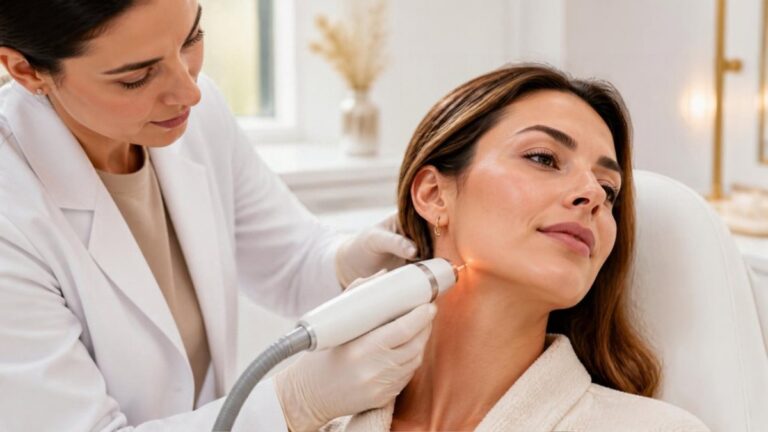
A fine laser fiber is inserted through tiny entry points in the skin. The fiber works on three mechanisms simultaneously:
- Melts small pockets of fat under the skin
- Tightens existing collagen fibers immediately through thermal contraction
- Triggers new collagen and elastin production over the following months
It’s particularly effective on the lower face, jowls, neck, submental fullness, and small body areas like the knees, inner thighs, and bra fat.
The treatment runs under local anesthesia, takes 30–60 minutes, and has minimal downtime — usually 24–72 hours of mild redness or swelling.
How HIFU Works
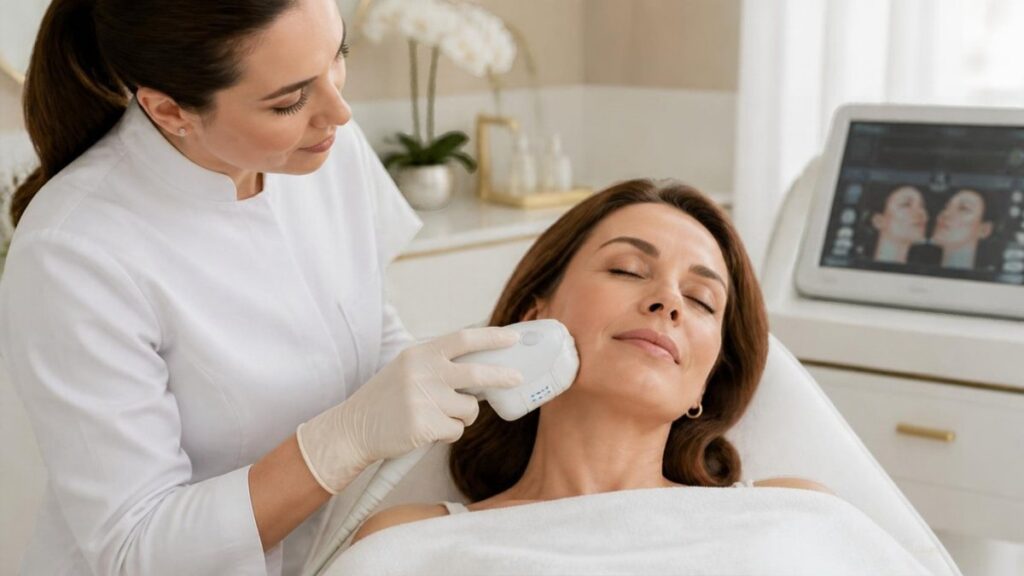
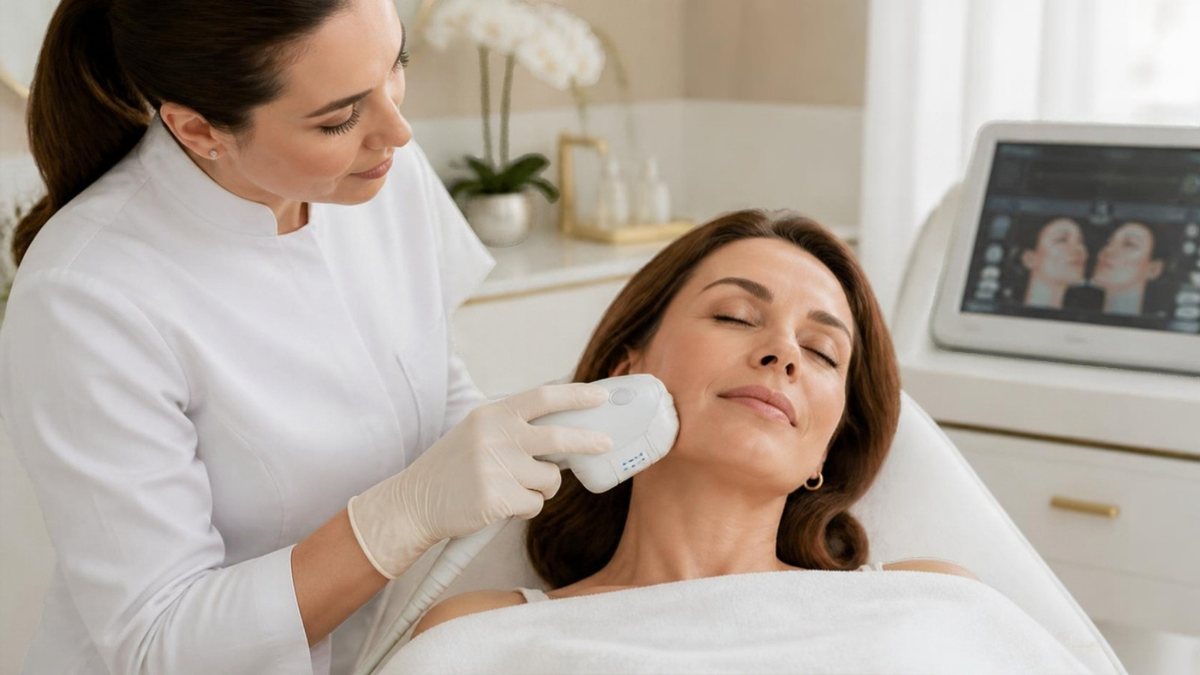
HIFU delivers focused ultrasound energy through the skin’s surface to specific depths, including the SMAS layer — the same deep tissue that surgeons tighten in a facelift. It:
- Heats tissue at precise pre-programmed depths
- Triggers collagen and elastin production
- Produces gradual tightening over months
HIFU is fully non-invasive, requires no anesthesia, and has essentially zero downtime.
Endolift vs HIFU: Results
Endolift:
- Visible tightening starts at 1–2 weeks
- Significant improvement at 1–3 months
- Final results at 6–12 months
- Lasts 2–3 years on average
- Reduces small fat pockets along with skin tightening
HIFU:
- Subtle tightening starts at 2–4 weeks
- Results build progressively through 3–6 months
- Lasts 12–18 months on average
- Doesn’t reduce fat
For the week-by-week detail, see our Endolift results timeline. Endolift produces a more dramatic result in a single session. HIFU produces a gentler result that still meaningfully improves mild laxity.
Endolift vs HIFU: Downtime and Pain
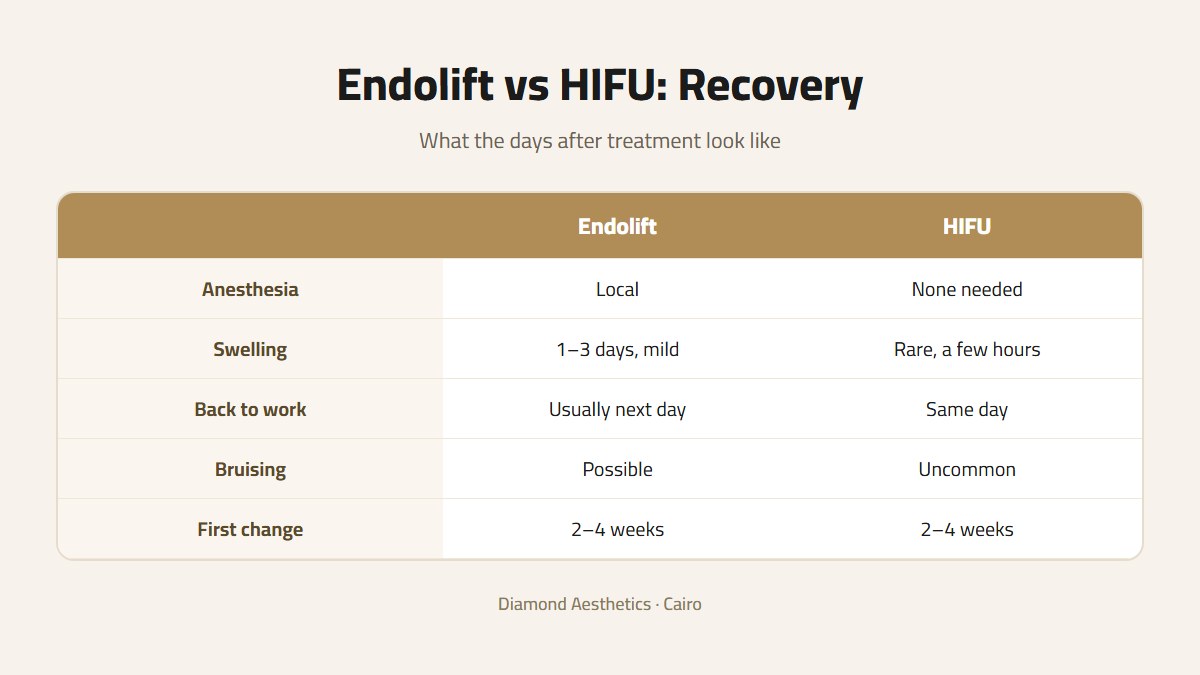
Endolift:
- Local anesthesia, minimal discomfort during the procedure
- Mild swelling, bruising, or redness for 24–72 hours
- Most patients return to work the next day
- Entry points heal completely within days
HIFU:
- No anesthesia
- Mild heat or pinpoint discomfort during treatment
- No downtime, return to normal activity immediately
- Brief redness for a few hours
If avoiding any downtime is the priority, HIFU wins. If producing a stronger result in one session matters more, Endolift wins.
Best Treatment Areas
Endolift works well for:
- Double chin and jowls
- Lower face laxity
- Neck banding and laxity
- Small fat pockets (knees, inner thighs, upper arms)
- Bra fat
- Submental fullness
HIFU works well for:
- Mild to moderate facial laxity
- Early aging signs
- Brow lift and the upper face
- Neck tightening
- Maintenance between or after surgery
- Body tightening on larger surface areas
Endolift or HIFU for the Jawline, Neck and Double Chin?
These are the areas where the endolift vs HIFU question comes up most. When the jawline has lost definition because of a small amount of fat under the chin plus loosening skin, Endolift usually gives the clearer change, because it treats both the fat and the skin. When the jawline is still well defined and the concern is early softening or fine crepey skin on the neck, HIFU is often enough — with no downtime. A short examination in clinic is the fastest way to tell which group you’re in.
Who Should Choose Endolift
The candidate profile:
- Moderate skin laxity (not mild, not severe)
- Wants a stronger, more dramatic result
- Has small fat pockets along with the laxity
- Doesn’t mind 1–2 days of mild downtime
- Prefers a single-session approach
- Wants results that last longer (2–3 years)
Who Should Choose HIFU
The candidate profile:
- Mild skin laxity
- Wants zero downtime
- Uncomfortable with anything minimally invasive
- Looking for maintenance after surgery
- Wants a more accessible price point per session
- Prefers gradual, conservative improvement
Endolift vs HIFU Cost: What Affects the Price
HIFU costs less per session but most patients need 1–2 sessions per year for maintenance. Endolift costs more per session but typically only requires a session every 2–3 years. The cost per year of result ends up similar — patients usually pick based on downtime tolerance and severity of laxity rather than cost alone.
The final cost of either treatment depends on the area treated, the number of sessions your skin needs and whether the treatments are combined. Your price is confirmed after the consultation. In Egypt, both treatments are considerably more affordable than in Europe or the U.S.
Combining Both
A common strategy that works particularly well:
- Endolift as the primary lifting treatment, every 2–3 years
- HIFU as ongoing maintenance every 12–18 months
This combination produces long-term results that rival what surgery delivers, without the recovery or scar trade-offs.
Side Effects and Safety
Both are established, widely used treatments and are considered safe in experienced hands.
- Endolift: Bruising, swelling, mild redness, all temporary
- HIFU: Mild redness, occasional small bumps that resolve within days
Serious complications are uncommon with both. Provider selection matters more than the device choice — both technologies in skilled hands produce clean results; either one in inexperienced hands produces inconsistent results.
Endolift vs HIFU: The Honest Answer
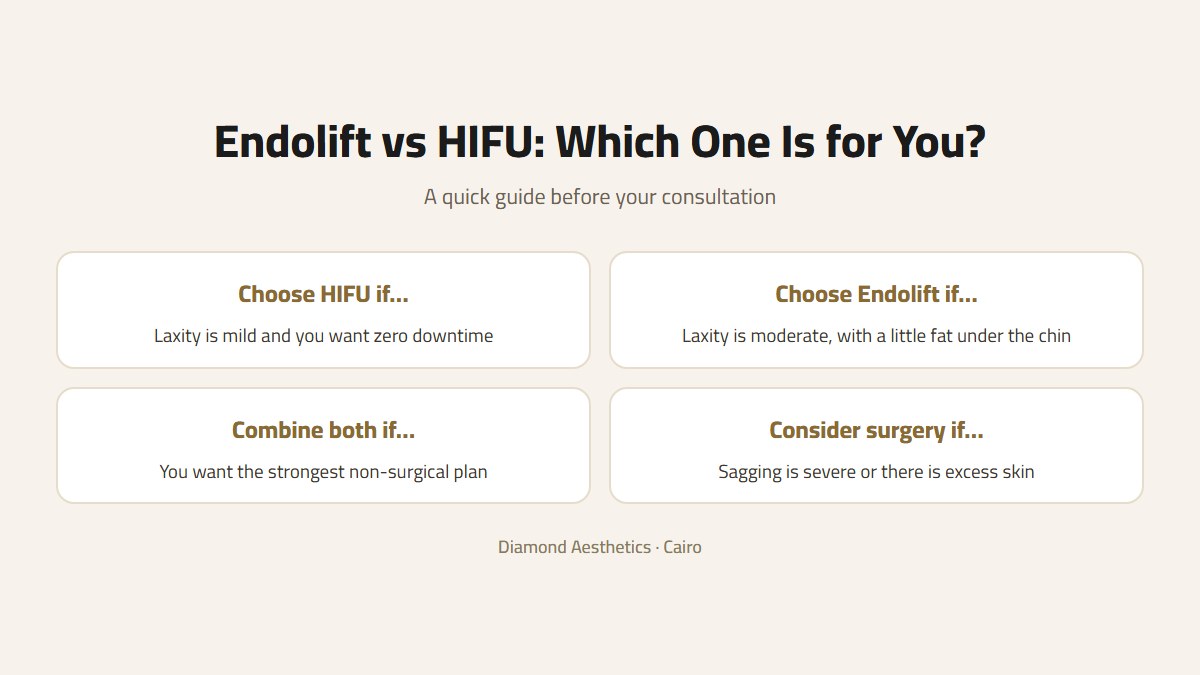
Mild laxity with zero downtime preference → HIFU. Moderate laxity, small fat pockets, willingness to accept 1–2 days of recovery → Endolift. Patients pursuing the strongest non-surgical lifting protocol → both, used strategically over time.
Severe laxity isn’t reachable with either tool. That conversation belongs in the surgical consultation.
Endolift vs HIFU in one paragraph: in the endolift vs HIFU decision, HIFU is the gentler, no-downtime option for mild laxity, while Endolift is the stronger single-session option for moderate laxity with small fat pockets. Clinical studies on focused ultrasound, such as this study of HIFU for facial laxity, show gradual tightening over months — the same pattern patients see with Endolift. The right endolift vs HIFU answer depends on your skin, which is why it starts with an examination.
FAQ
Endolift vs HIFU: Frequently Asked Questions
Which is better, Endolift or HIFU?
Neither is better for everyone. HIFU suits mild laxity with no downtime; Endolift suits moderate laxity, especially with small fat pockets, and gives a stronger result from one session.
Is Endolift more painful than HIFU?
Endolift is done under local anesthesia, so most people feel pressure and warmth. HIFU needs no anesthesia but can feel hot or prickly at points during treatment.
How long do Endolift and HIFU results last?
Endolift results typically last around 2–3 years. HIFU results typically last around 12–18 months, so it is often repeated as maintenance.
Can Endolift and HIFU be combined?
Yes. A common plan is Endolift as the main lifting treatment and HIFU as maintenance between Endolift sessions.
Which is better for a double chin?
When there is a small amount of fat under the chin with loose skin, Endolift is usually more effective, because HIFU does not reduce fat.
The Bottom Line
Endolift vs HIFU isn’t a debate about which technology is better. They’re solving different versions of the same general problem at different intensity levels. HIFU is gentler. Endolift is stronger. Both work in experienced hands.
At Diamond Aesthetics in Egypt, the consultation looks at the actual skin laxity, the patient’s downtime tolerance, and the realistic goals — and recommends the technology, or combination of technologies, that produces the result the patient came in hoping for. Book a consultation with our skin and aesthetic dermatology team, or read more about Endolift laser treatment and skin tightening without surgery.