
PRP vs Mesotherapy for Hair Loss: A Real Comparison
So you’ve decided to do something about your thinning hair before it gets worse — good. Now you’re staring at two treatments that sound suspiciously similar: PRP and mesotherapy. Both involve injections into the scalp. Both promise thicker, healthier hair. Both come with confident clinic websites and before-and-after galleries. So which one actually deserves your money?
Here’s the thing nobody tells you upfront: they’re not really competitors in the way the internet frames them. They work differently, suit different situations, and are sometimes even used together. Dr. Sherif Hegazy, founder of Diamond Aesthetics in Cairo and an ISHRS member with over 10,000 procedures, gets this question constantly — and the honest answer is “it depends,” followed by the specifics that actually help you decide. Let’s walk through them.
Direct Answer
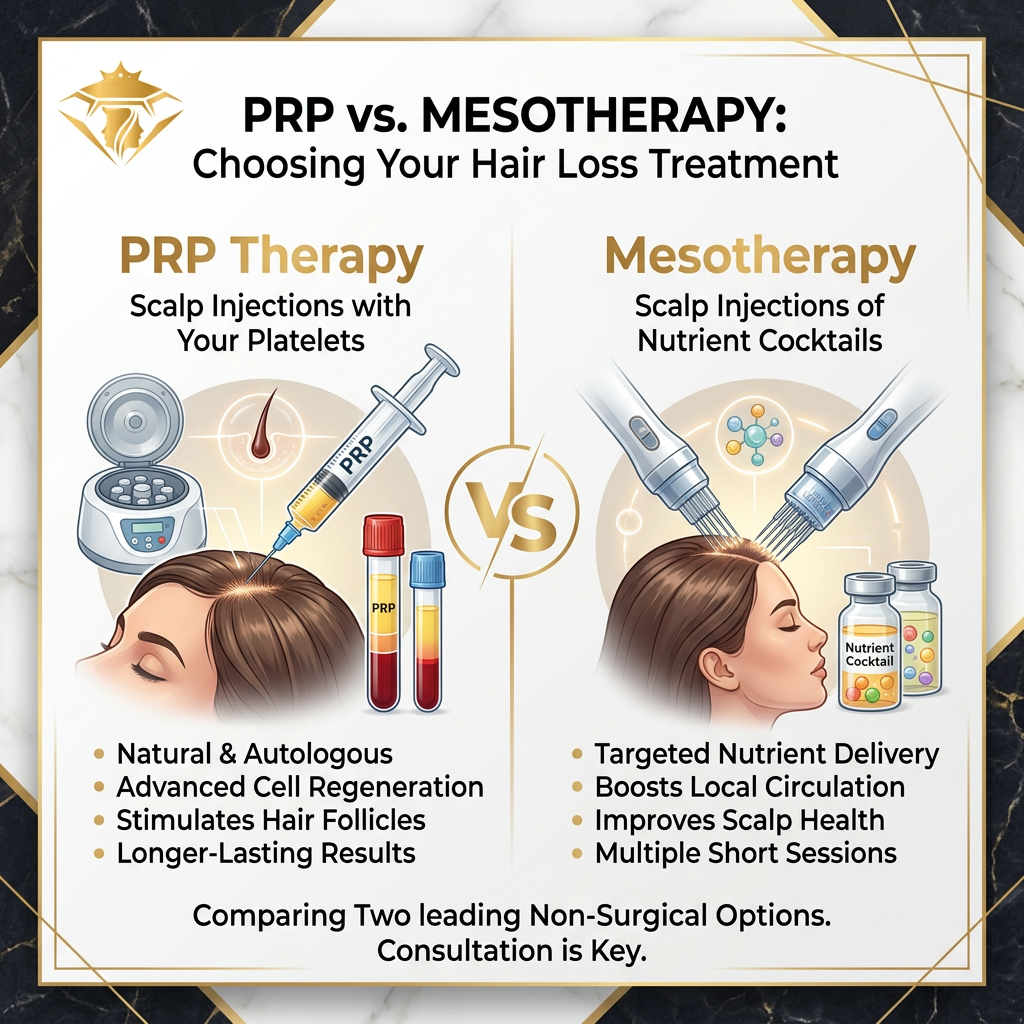
PRP (platelet-rich plasma) injects a concentration of your own platelets into the scalp to release growth factors that strengthen follicles. Mesotherapy injects a custom cocktail of vitamins, minerals, amino acids, and medications to nourish the scalp and support hair. PRP is autologous and better supported for androgenetic alopecia; mesotherapy is more customizable and addresses nutritional and circulatory factors. Neither is universally “better” — the right choice depends on your hair loss type, and they’re sometimes combined.
What Is PRP, Really?
PRP uses your own blood. A small sample is drawn, spun in a centrifuge to concentrate the platelets, and the platelet-rich plasma is injected into the scalp.
Why platelets? They’re packed with growth factors — signaling proteins that support tissue repair and cellular activity. The idea is to flood thinning follicles with a concentrated dose of your body’s own regenerative signals, encouraging stronger, thicker growth.
Because it comes from you, allergic reaction is essentially a non-issue. That autologous nature is one of PRP’s biggest selling points.
What Is Mesotherapy, Really?
Mesotherapy takes a different approach. Instead of using your blood, it delivers a custom-mixed cocktail directly into the scalp’s middle layer (the mesoderm). The mix typically includes:
- Vitamins (B-complex, biotin)
- Minerals and trace elements
- Amino acids
- Hyaluronic acid
- Sometimes medications or plant-based extracts
The goal is to nourish the scalp, improve local circulation, and create better conditions for hair growth. Think of it less as a regenerative signal (PRP) and more as targeted nutrition and environmental support delivered exactly where it’s needed.
The customizability is the appeal — the cocktail can be tailored to the individual scalp and cause of thinning.
The Honest Head-to-Head
| Factor | PRP | Mesotherapy |
|---|---|---|
| What’s injected | Your own concentrated platelets | Custom vitamin/nutrient/medication mix |
| Mechanism | Growth-factor stimulation | Nourishment + circulation support |
| Source | Autologous (from you) | External ingredients |
| Customization | Limited | Highly customizable |
| Evidence base | Better established for AGA | More variable |
| Allergy risk | Very low | Low, depends on ingredients |
| Sessions | Several + maintenance | Several + maintenance |
| Best for | Androgenetic alopecia, follicle strengthening | Nutritional/circulatory support, general thinning |
| Cost | Moderate | Varies with cocktail |
So Which One Actually Wins?
Let’s be real — you want a verdict, not a fence-sit. Here’s the practical breakdown:
PRP tends to win when:
– The thinning is androgenetic (pattern) hair loss
– You want the best-supported regenerative option
– You prefer a treatment using only your own biology
– You’re supporting or enhancing a hair transplant
Mesotherapy tends to win when:
– The cause includes nutritional or circulatory factors
– A highly customized approach suits your scalp
– You want to combine multiple supportive ingredients in one treatment
– PRP alone hasn’t delivered enough on its own
And sometimes the answer is both. Used together, they can complement each other — PRP delivering growth-factor stimulation, mesotherapy delivering targeted nourishment. A good clinic will tell you when combining makes sense rather than pushing one.
What to Realistically Expect
Whichever you choose, manage expectations:
- Neither is an overnight fix. Results build over months.
- Both need maintenance. A single session won’t sustain results.
- Both work best early. They support existing follicles — they can’t revive what’s already gone.
- Both are supportive, not surgical. For bald areas, only a transplant restores hair.
A typical course involves several sessions a few weeks apart, then periodic maintenance. Patience and consistency matter more than which treatment you pick.
Who Should Skip Both (For Now)
These treatments aren’t right for everyone:
- If your hair loss has an untreated underlying cause (thyroid, iron deficiency, hormonal), address that first
- If you have no remaining follicles in the area, a transplant is the realistic route
- If you expect dramatic regrowth from a couple of sessions, recalibrate before spending
This is exactly why a proper consultation beats self-diagnosis. The right treatment depends on why you’re losing hair.
Common Misconceptions
“PRP and mesotherapy are basically the same thing.”
They share the injection delivery but differ fundamentally — PRP uses your platelets; mesotherapy uses a nutrient cocktail.
“One session will fix my hair.”
Both require several sessions plus maintenance. Results build gradually.
“They can regrow hair on bald patches.”
Both support existing follicles. Neither creates hair where follicles are gone.
“More ingredients in mesotherapy means better results.”
A bigger cocktail isn’t automatically better. The right, evidence-informed mix matters more than a long list.
“You have to choose one or the other.”
They’re sometimes combined for complementary benefits.
Frequently Asked Questions
What’s the difference between PRP and mesotherapy?
PRP injects your own concentrated platelets to release growth factors. Mesotherapy injects a custom cocktail of vitamins, minerals, and other ingredients to nourish the scalp. Different mechanisms, same delivery route.
Which is better for hair loss, PRP or mesotherapy?
Neither is universally better. PRP is better supported for androgenetic alopecia; mesotherapy is more customizable for nutritional and circulatory factors. The right choice depends on your hair loss type.
Can PRP and mesotherapy be combined?
Yes. They can complement each other — PRP for growth-factor stimulation, mesotherapy for targeted nourishment — when a clinic determines it suits your case.
How many sessions do I need?
Both typically require several sessions spaced weeks apart, followed by periodic maintenance to sustain results.
Is PRP safe?
Yes. Because it uses your own blood, allergic reaction is extremely unlikely. It has a strong safety profile.
Is mesotherapy safe?
Generally yes, though safety depends on the ingredients used. Choose a clinic that uses appropriate, well-considered formulations.
When will I see results?
Both build results over months — typically reduced shedding first, then gradual thickening over 3–6 months, with maintenance to sustain.
Can these treatments regrow hair on bald areas?
No. Both support existing follicles. Bald areas with no follicles require a hair transplant.
Which is cheaper, PRP or mesotherapy?
It varies by clinic and, for mesotherapy, the cocktail used. PRP costs are usually moderate; budget for the full session series either way.
Do PRP or mesotherapy hurt?
Discomfort is minor. The scalp can be numbed, and sessions are quick.
Are they suitable for women?
Yes. Both are used for female thinning and can be tailored to the individual.
Should I do PRP or mesotherapy before a hair transplant?
Either can support hair health around a transplant. A consultation determines the best timing and combination for your case.
Key Takeaways
- PRP uses your own platelets; mesotherapy uses a custom nutrient cocktail
- PRP is better supported for pattern hair loss; mesotherapy is more customizable
- Neither is universally better — it depends on your hair loss cause
- They’re sometimes combined for complementary benefits
- Both need several sessions plus maintenance and work best on thinning, not bald, areas
- Treat any underlying cause (thyroid, iron, hormones) first
Expert Summary
Dr. Sherif Hegazy on PRP versus mesotherapy: “Patients want me to crown a winner, and I understand why, but it’s the wrong question. PRP and mesotherapy do different jobs. If someone has classic pattern thinning and wants the best-supported, all-natural option, I lean PRP. If the picture involves nutritional or circulatory factors, or PRP alone isn’t enough, mesotherapy earns its place — and sometimes I use both. What actually decides the result isn’t the label. It’s correctly identifying why the hair is thinning in the first place, and committing to the full course. Skip the diagnosis and either treatment underdelivers.”
At Diamond Aesthetics in Cairo, Dr. Hegazy matches PRP, mesotherapy, or a combination to the underlying cause of each patient’s hair loss, rather than promoting one treatment as a universal answer.