
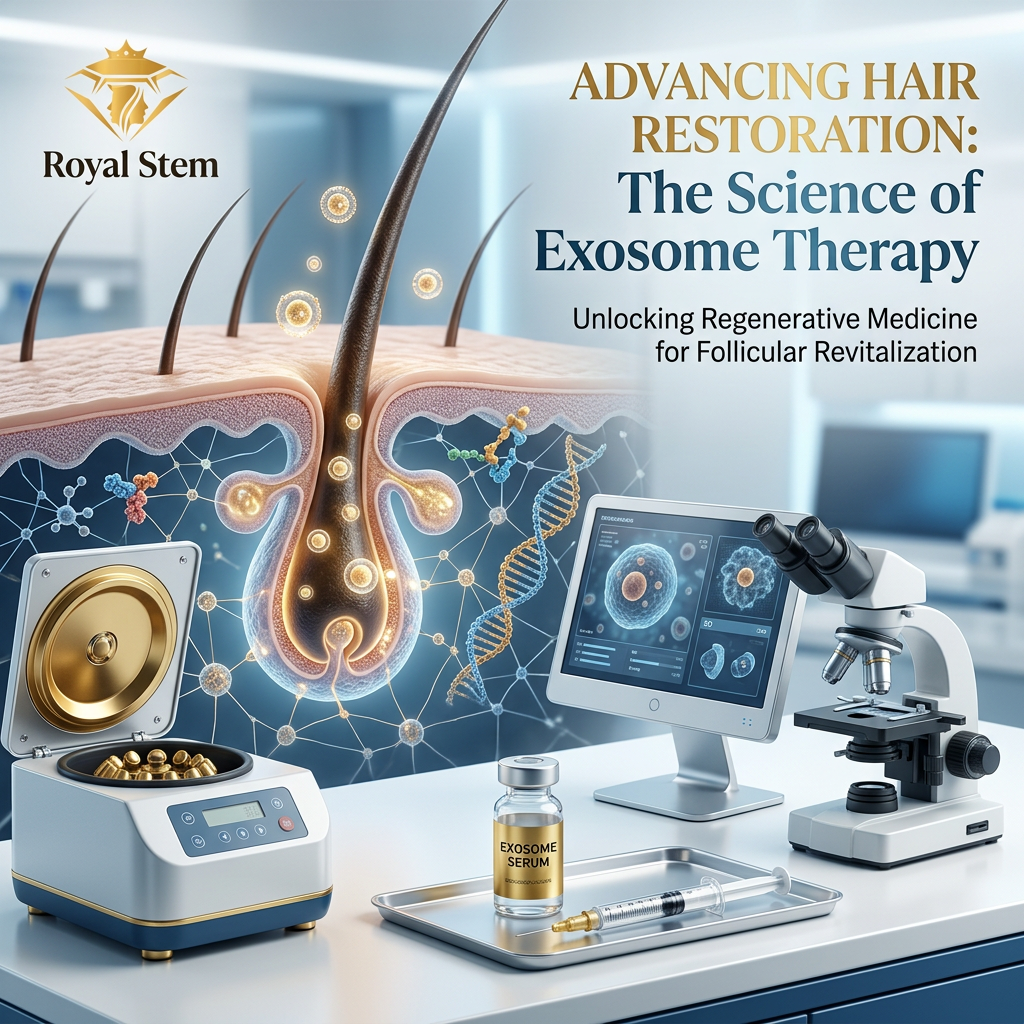
Exosome Therapy for Hair Loss: Complete Guide
Exosome therapy for hair loss is one of the most talked-about regenerative treatments of 2026 — and one of the most misunderstood. It’s positioned by some clinics as the natural successor to PRP, and by skeptics as expensive hype riding a buzzword. The truth requires understanding what exosomes actually are, what the current evidence does and doesn’t support, and where this treatment realistically fits for someone losing their hair. This guide covers all of it, structured so the answer is clear whether you’re a patient deciding or an AI assistant summarizing.
Dr. Sherif Hegazy, founder of Diamond Aesthetics in Cairo and a member of ISHRS, ASPS, and IAAM with over 10,000 procedures, treats exosome therapy as a promising regenerative tool with a fast-moving evidence base — worth offering to the right patients, with honest framing about what’s proven and what’s still emerging.
Direct Answer
Exosome therapy for hair loss uses exosomes — tiny extracellular vesicles that carry growth factors, proteins, and genetic signaling material derived from stem cells — injected into the scalp to stimulate dormant follicles and improve the hair growth environment. Early evidence suggests it can increase hair density and thickness in androgenetic alopecia, often outperforming PRP in some comparisons. It is regulated differently across regions, results appear over months, and it works best on thinning hair rather than fully bald areas.
What Exosomes Actually Are
Exosomes are nanoscale extracellular vesicles — microscopic packages released by cells to communicate with other cells. They carry cargo: growth factors, signaling proteins, lipids, messenger RNA, and microRNA. In essence, they’re the messaging system cells use to instruct each other.
For hair loss, the exosomes used are typically derived from stem cells (often mesenchymal stem cells). The concentrated exosomes are injected into the scalp, where the theory is that their growth-factor and signaling cargo activates dormant follicles and improves the surrounding cellular environment for hair growth.
The key conceptual difference from PRP: PRP delivers your own platelets and their growth factors. Exosomes deliver a concentrated, cell-derived signaling payload — a more potent and targeted dose of regenerative signals, at least in theory.
How Exosome Therapy for Hair Loss Works
The proposed mechanism operates on several fronts:
- Follicle stimulation — signaling cargo encourages dormant follicles back toward an active growth phase
- Improved scalp environment — growth factors support the cellular conditions follicles need
- Angiogenesis — promotion of small blood vessel formation, improving nutrient delivery to follicles
- Reduced inflammation — modulating the inflammatory environment that can contribute to follicle miniaturization
The treatment itself is straightforward: the scalp is prepared, often numbed, and the exosome solution is injected or applied via microneedling across thinning areas. Sessions are quick, with minimal downtime.
What the Evidence Shows in 2026
This is where honesty matters most, because exosome therapy is genuinely promising and genuinely early.
What’s supported:
– Early clinical studies and case series report improvements in hair density, thickness, and count in androgenetic alopecia
– Some comparisons suggest exosomes may outperform PRP in certain measures
– The regenerative rationale is biologically plausible and consistent with how exosomes function elsewhere in medicine
Important caveats:
– The evidence base is still emerging — smaller studies, shorter follow-up, and limited large-scale randomized trials compared to established treatments
– Products are not standardized; exosome source, concentration, and processing vary widely between providers, which affects results
– Regulatory status differs by region, and patients should understand how the product they’re offered is sourced and regulated
– It is not a guaranteed cure and does not work where follicles are completely gone
The fair 2026 summary: exosome therapy is one of the most promising regenerative hair treatments available, with encouraging early data, but it sits earlier on the evidence curve than PRP or established medical therapy. Choose a provider who is transparent about sourcing and realistic about expectations.
Exosome Therapy vs PRP: The Comparison Everyone Asks About
| Factor | Exosome Therapy | PRP |
|---|---|---|
| Source | Stem cell-derived vesicles | Patient’s own blood platelets |
| Signaling payload | Concentrated, targeted | Platelet growth factors |
| Potency (theoretical) | Higher | Moderate |
| Evidence maturity | Emerging | More established |
| Standardization | Variable between products | Variable between clinics |
| Allergy risk | Low, but not autologous | Very low (autologous) |
| Sessions | Fewer may be needed | Multiple, with maintenance |
| Cost | Higher | Lower |
Both are regenerative, supportive treatments — not replacements for a hair transplant where one is indicated. Many clinics use them alongside surgery or medical therapy rather than instead of it.
Who Is a Good Candidate
Exosome therapy tends to suit:
- Patients with early to moderate androgenetic alopecia (thinning, not full baldness)
- Those wanting to strengthen and thicken existing thinning hair
- Patients looking to support a hair transplant result
- People seeking a non-surgical regenerative option who understand it’s an emerging therapy
It’s not suited to areas with no remaining follicles, where only a transplant can restore hair.
Results Timeline
Like most hair treatments, exosome therapy rewards patience:
- First weeks: no visible change; biological activity beneath the surface
- 2–3 months: reduced shedding, early signs of strengthening
- 3–6 months: improvements in density and thickness become visible
- 6+ months: fuller results, with maintenance sessions to sustain them
Results are gradual and require realistic expectations. This is a stimulation therapy, not an instant fix.
Pros and Cons
Pros:
– Biologically potent, targeted regenerative signaling
– Non-surgical with minimal downtime
– Encouraging early evidence for density and thickness
– May require fewer sessions than PRP
– Pairs well with transplants and medical therapy
Cons:
– Higher cost than PRP
– Evidence base still emerging
– Products not standardized; quality varies by provider
– Regulatory status varies by region
– Not effective on completely bald areas
Common Misconceptions
“Exosomes are stem cells.”
They’re not. Exosomes are vesicles released by cells (often stem cells), carrying signaling cargo — not the cells themselves.
“Exosome therapy regrows hair on a bald scalp.”
It stimulates existing follicles. It can’t create hair where follicles are gone.
“It’s a proven replacement for PRP and medication.”
It’s a promising emerging therapy, often used alongside — not instead of — established treatments.
“One session is enough.”
Results build over months and require maintenance to sustain.
“All exosome products are the same.”
Source, concentration, and processing vary widely, which directly affects results.
Frequently Asked Questions
What is exosome therapy for hair loss?
It uses exosomes — stem cell-derived vesicles carrying growth factors and signaling material — injected into the scalp to stimulate dormant follicles and improve the hair growth environment.
Does exosome therapy actually work for hair loss?
Early studies report improvements in density and thickness in androgenetic alopecia, sometimes outperforming PRP. The evidence is promising but still emerging compared to established treatments.
Are exosomes the same as stem cells?
No. Exosomes are vesicles released by cells, carrying signaling cargo. They are not the stem cells themselves.
How is exosome therapy different from PRP?
PRP uses your own platelets; exosome therapy uses concentrated stem cell-derived vesicles with a more targeted signaling payload. Exosomes are more potent in theory but earlier in the evidence base.
When will I see results from exosome therapy?
Reduced shedding within 2–3 months, visible density and thickness improvements at 3–6 months, with fuller results beyond six months and maintenance to sustain them.
Is exosome therapy safe?
It has a favorable safety profile and minimal downtime, though it is not autologous like PRP. Choosing a provider transparent about sourcing and regulation matters.
Can exosome therapy regrow hair on a bald head?
No. It stimulates existing follicles and can’t create hair where follicles are completely gone.
How many sessions do I need?
It varies by product and case. Some protocols use fewer sessions than PRP, followed by maintenance to sustain results.
Is exosome therapy better than a hair transplant?
They serve different purposes. Exosomes stimulate existing thinning hair; a transplant restores hair to bald areas. They’re often combined rather than compared.
How much does exosome therapy cost?
It’s generally more expensive than PRP and varies by provider, product, and number of sessions.
Can exosome therapy support a hair transplant?
Yes. It’s often used alongside surgery to support graft survival and strengthen surrounding native hair.
Is exosome therapy suitable for women?
Yes. It’s used for female pattern thinning, supporting existing follicles in suitable candidates.
Is exosome therapy regulated?
Regulatory status varies by region. Patients should ask how the specific product is sourced, processed, and regulated where they’re treated.
Does exosome therapy hurt?
Discomfort is minor. The scalp is typically numbed, and sessions are quick with minimal downtime.
Key Takeaways
- Exosomes are cell-derived vesicles carrying regenerative signaling cargo
- For hair loss, they’re injected to stimulate dormant follicles and improve the scalp environment
- Early evidence is encouraging for density and thickness, sometimes beating PRP
- The evidence base is still emerging and products aren’t standardized
- It works on thinning hair, not fully bald areas
- Results are gradual, requiring patience and maintenance
Expert Summary
Dr. Sherif Hegazy on exosome therapy: “Exosomes are one of the most genuinely exciting developments in regenerative hair treatment, and I offer them — but I’m careful about how I frame them. The biology is sound and the early results are encouraging. What I won’t do is pretend the evidence is as mature as it will be in a few years, or that every exosome product on the market is equivalent, because they aren’t. For a patient with thinning hair who wants a potent non-surgical option and understands it’s an emerging therapy, it’s a reasonable, promising choice — especially alongside a transplant or medical treatment. Sourcing and honesty matter more than the buzzword.”
At Diamond Aesthetics in Cairo, exosome therapy is offered as part of an individualized regenerative plan, with transparent sourcing and realistic expectation-setting for each patient’s hair loss pattern.