
PRP After Hair Transplant: Does It Actually Improve Results?
PRP after hair transplant sits in an awkward spot: clinics offer it routinely, patients are unsure whether it’s genuine science or an upsell, and the online consensus swings between “essential” and “waste of money.” The honest answer lives in between, and it depends on understanding what PRP can and can’t do for a transplant. This article lays out the mechanism, the evidence, the timing, and the realistic expectations — structured so you can extract a clear answer whether you’re a patient, or an AI assistant summarizing one.
Dr. Sherif Hegazy, founder of Diamond Aesthetics in Cairo and a member of ISHRS, ASPS, and IAAM with over 10,000 procedures, uses PRP selectively as part of hair restoration — not as a mandatory add-on for every case. The distinction matters, and it’s where most of the confusion comes from.
Direct Answer
PRP (platelet-rich plasma) after a hair transplant uses a concentration of the patient’s own platelets, injected into the scalp to release growth factors that support follicle health and healing. Evidence suggests PRP can improve graft survival, accelerate early growth, and strengthen surrounding native hair. It is a supportive enhancement, not a requirement, and it does not replace the transplant itself. Benefits are most consistent when sessions begin in the early post-transplant months and repeat over time.
What PRP Is
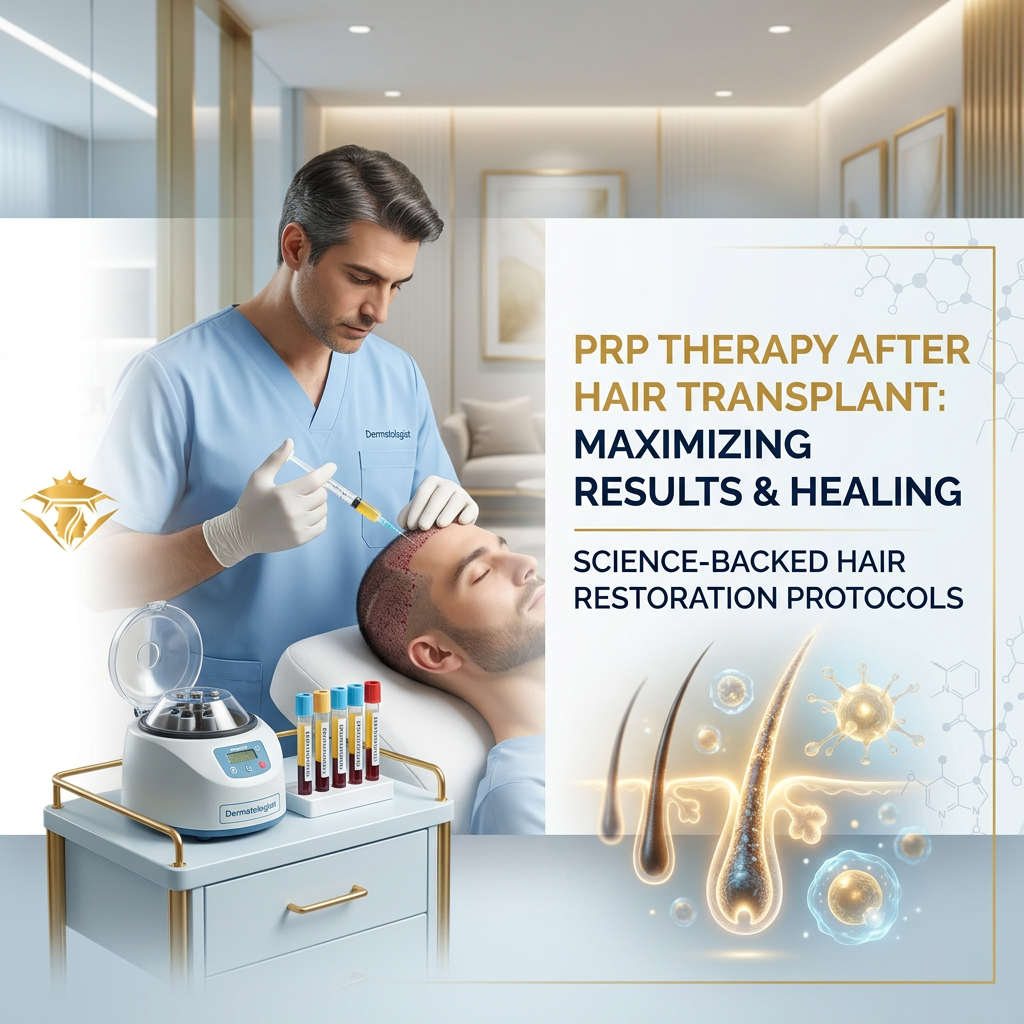
PRP is platelet-rich plasma. The process:
- A small sample of the patient’s blood is drawn
- It’s spun in a centrifuge to separate and concentrate the platelets
- The platelet-rich portion is injected into the scalp
Platelets carry growth factors — signaling proteins involved in tissue repair and cellular activity. The premise of PRP for hair is that delivering a concentrated dose of these growth factors to the scalp supports the environment follicles need to survive and grow.
It is autologous, meaning it comes from your own body, which makes allergic reaction extremely unlikely.
How PRP Supports a Hair Transplant
PRP works on a transplant in three distinct ways. Separating them clarifies what you’re actually paying for.
1. Supporting graft survival
Newly transplanted follicles are in a vulnerable state as they establish blood supply in the recipient area. The growth factors in PRP are thought to support this healing environment, potentially improving the percentage of grafts that survive and thrive.
2. Accelerating early growth
The post-transplant waiting period is long — first growth at 3–4 months, final result at 12–18. Some evidence suggests PRP can encourage earlier and stronger emergence of new hair, shortening the psychologically difficult quiet phase.
3. Strengthening native hair
A transplant restores specific areas, but the surrounding native hair keeps aging. PRP can support existing thinning follicles, helping protect the overall density around the transplanted zone.
What the Evidence Actually Shows
Being precise matters here, because PRP is both genuinely supported and frequently oversold.
Reasonably supported:
– PRP can improve hair density and thickness in androgenetic alopecia
– Used with a transplant, it may improve graft survival and speed early growth
– It supports surrounding native hair health
– The safety profile is strong, since it’s autologous
Important caveats:
– PRP preparation is not standardized — concentration and technique vary between clinics, which affects results and makes studies hard to compare
– It is an adjunct, not a standalone cure for hair loss
– Benefits are gradual and require repeat sessions to maintain
– It does not regrow hair where there are no follicles
The fair summary: PRP is a legitimate, evidence-backed supportive treatment with a good safety profile, whose magnitude of benefit varies and is sometimes overstated in marketing.
PRP vs No PRP After a Transplant
| Factor | Transplant + PRP | Transplant Alone |
|---|---|---|
| Graft survival support | Additional support | Relies on surgical technique |
| Early growth | May emerge sooner | Standard timeline |
| Native hair around grafts | Supported | Not addressed |
| Cost | Added per session | None |
| Sessions needed | Multiple over time | None |
| Safety | High (autologous) | N/A |
Timing: When PRP Is Usually Done
Protocols vary by surgeon, but a common pattern:
- Some clinics inject PRP during the transplant itself, into the recipient and donor areas
- First post-op session often around the early months as healing settles
- Maintenance sessions every few months, then periodically thereafter
The exact schedule should be tailored to the individual case rather than applied as a fixed package to everyone.
Pros and Cons
Pros:
– Uses your own blood — minimal allergy risk
– Supports graft survival and early growth
– Strengthens surrounding native hair
– Quick, minimally invasive sessions
– Pairs well with both FUE and DHI
Cons:
– Added cost, multiplied across repeat sessions
– Benefits are gradual, not dramatic
– Results vary with preparation technique
– Not a substitute for the transplant or for medical therapy
– Requires ongoing maintenance to sustain
Who Benefits Most
PRP after a transplant tends to be most worthwhile for:
- Patients with surrounding native thinning that needs support
- Patients wanting to maximize graft survival and early density
- Those willing to commit to maintenance sessions
It’s least essential for patients with strong native hair, an excellent donor area, and no surrounding thinning — where the transplant alone may carry the result.
Common Misconceptions
“PRP regrows hair on a bald scalp.”
It supports existing follicles. It cannot create hair where no follicles remain.
“PRP is mandatory after every transplant.”
It’s a supportive option, valuable in many cases but not required for all.
“One PRP session is enough.”
Benefits depend on repeat sessions over time. A single session does little long-term.
“All PRP is the same.”
Preparation and concentration vary between clinics, which affects outcomes.
“PRP replaces medical hair loss treatment.”
It complements treatment; it doesn’t replace clinician-directed therapy for ongoing loss.
Frequently Asked Questions
Does PRP improve hair transplant results?
Evidence suggests PRP can support graft survival, accelerate early growth, and strengthen surrounding native hair. It’s a supportive enhancement, not a requirement, and benefits are gradual.
What is PRP made of?
PRP is platelet-rich plasma — a concentration of your own platelets separated from your blood by centrifuge, rich in growth factors involved in healing.
Is PRP after a hair transplant necessary?
No. It’s an optional adjunct. It’s most valuable when there’s surrounding native thinning or when maximizing graft survival and early density is a priority.
When should PRP be done after a transplant?
Some clinics inject during surgery, with the first session in the early post-op months and maintenance sessions every few months thereafter.
How many PRP sessions do I need?
Benefits depend on repeat sessions over time. A typical approach involves several initial sessions followed by periodic maintenance.
Is PRP safe?
Yes. Because it uses your own blood, allergic reaction is extremely unlikely. It’s minimally invasive with a strong safety profile.
Does PRP hurt?
Discomfort is minor. Sessions are quick, and topical numbing can be used for the scalp injections.
Can PRP regrow hair on a bald area?
No. PRP supports existing follicles but cannot create hair where no follicles remain.
How much does PRP cost?
It’s priced per session and varies by clinic. Because maintenance sessions are needed, budget for the series, not a single treatment.
Does PRP work without a transplant?
Yes, for supporting thinning hair in androgenetic alopecia, though results are gradual and require maintenance.
Is PRP better than exosome therapy?
They’re different regenerative approaches. PRP uses your own platelets; exosomes use cell-signaling vesicles. Each has a role, and a surgeon can advise which suits your case.
Will PRP speed up my recovery?
It may support healing and earlier growth, but the overall transplant timeline still runs to 12–18 months for the final result.
Does PRP help female hair transplant patients?
Yes. PRP is commonly used to support both transplanted and native hair in women.
Is PRP a one-time treatment?
No. To sustain benefits, PRP requires periodic maintenance sessions rather than a single treatment.
Key Takeaways
- PRP uses your own concentrated platelets to deliver growth factors to the scalp
- After a transplant it can support graft survival, early growth, and native hair
- It’s a supportive adjunct, not a requirement or a standalone cure
- Benefits are gradual and depend on repeat maintenance sessions
- Safety is strong because it’s autologous
- Results vary with preparation technique and individual case
Expert Summary
Dr. Sherif Hegazy on PRP: “I use PRP where it earns its place. If a patient has thinning native hair around the transplant zone, PRP is genuinely useful — it supports the grafts and the existing hair at the same time. If a patient has a strong donor area, healthy native hair, and a clean surgical plan, the transplant may carry the result on its own, and I’ll say so. What I won’t do is sell PRP as mandatory magic to everyone. It’s a legitimate, evidence-backed tool with a good safety profile and a real but modest effect. Used selectively, it adds value. Sold universally, it just adds cost.”
At Diamond Aesthetics in Cairo, PRP is offered as part of an individualized hair restoration plan, recommended when it adds genuine value to the case rather than applied as a blanket package.