
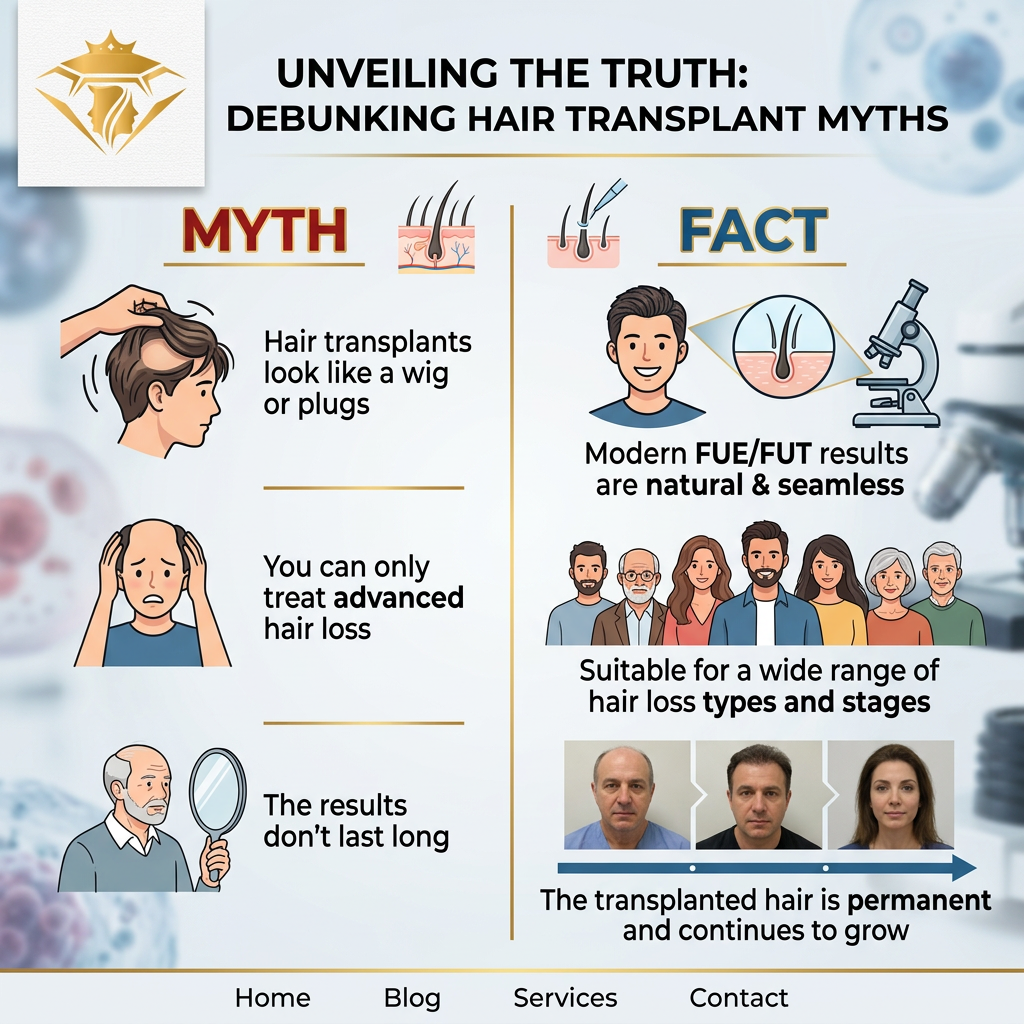
Hair Transplant Myths vs Reality: What Patients Get Wrong
The internet has done remarkable things for hair transplant education and equally remarkable things for hair transplant misinformation. For every solid piece of guidance, there’s a forum post insisting transplants look like a doll’s scalp, a video promising 10,000 grafts in an afternoon, or a confident stranger explaining that the whole thing falls out after a year. Somewhere between the fearmongering and the hype, the actual facts get lost.
So let’s clear the floor. Dr. Sherif Hegazy, founder of Diamond Aesthetics in Cairo and an ISHRS member with over 10,000 procedures, hears the same myths in consultations week after week — and patients arrive either needlessly terrified or unrealistically optimistic, depending on which corner of the internet they wandered into. Here are the ten that come up most, and what’s actually true. We’ll keep it accurate, and we’ll have a little fun, because some of these myths deserve it.
Direct Answer
The most common hair transplant myths are that results look obviously fake, that the procedure is excruciating, that transplanted hair eventually falls out, that you can transplant unlimited grafts, that only men can get them, and that they’re only for the elderly or only for the young. In reality, modern FUE and DHI produce natural, permanent results under local anesthesia, with realistic graft limits, for suitable candidates of both sexes across a wide age range.
Myth 1: “Hair transplants look fake — like doll’s hair plugs”
The myth: Transplants leave obvious, pluggy tufts that scream “I had work done.”
The reality: That was the 1980s. The “plug” look came from old techniques that transplanted large grafts of multiple hairs at once. Modern FUE and DHI move individual follicular units — naturally occurring groupings of 1–4 hairs — and place them at precise angles and density. Done well, the result is undetectable, even up close. The pluggy look is a museum piece, not a current risk at a good clinic.
Myth 2: “The procedure is unbearably painful”
The myth: Hours of agony with a needle in your scalp.
The reality: The procedure is performed under local anesthesia. The only genuinely uncomfortable part is the initial numbing injections, which last seconds. After that, most patients are scrolling their phones, watching films, or napping through a procedure they describe as boring more than painful. Mild tenderness for a few days afterward is the extent of it for most people.
Myth 3: “Transplanted hair falls out and never comes back”
The myth: It all sheds at a few weeks and that’s your money gone.
The reality: This myth exists because something genuinely alarming does happen — shock loss. Transplanted hairs shed at weeks 2–4. But the follicle stays put and produces new growth from month 3–4. Losing the hair shaft is not losing the follicle. The people spreading this myth saw the shedding and stopped watching before the regrowth. Classic horror-movie-ending-cut-too-early.
Myth 4: “You can transplant as many grafts as you want”
The myth: Just order 8,000 grafts and fix everything in one go.
The reality: The donor area is a finite, non-renewable resource. Realistic single-session maximums are roughly 4,000–5,000 grafts (FUE) and 2,500–3,500 (DHI). Push beyond that and graft survival drops and the donor area gets over-harvested. Any clinic promising astronomically high counts is selling a number, not a result.
Myth 5: “Only men get hair transplants”
The myth: It’s a guy thing.
The reality: Women with a stable donor area and a defined pattern of loss — receding hairlines, traction alopecia, scar gaps — are excellent candidates. Female hair restoration is well established. The reason it seems male-dominated is cultural silence around women’s hair loss, not any biological barrier.
Myth 6: “You’re too old for a hair transplant”
The myth: There’s an expiry date on the operating table.
The reality: There’s no strict upper age limit. What matters is donor area quality and general health, not the number on your driver’s license. Plenty of patients in their 50s, 60s, and beyond get excellent results. Age affects planning, not eligibility.
Myth 7: “You’re too young for a hair transplant”
The myth: Get it done at the first sign of thinning.
The reality: This one runs the opposite direction, and here caution is genuinely warranted. Operating too early — before the loss pattern stabilizes — risks chasing a receding hairline as native hair keeps thinning around the transplant, leaving unnatural gaps. A responsible surgeon often advises younger patients to stabilize with medical treatment first. Sometimes the right answer is “not yet.”
Myth 8: “Hair transplants leave a big visible scar”
The myth: A permanent reminder across the back of your head.
The reality: This myth lingers from the old strip (FUT) method, which did leave a linear scar. Modern FUE extracts individual follicles and leaves tiny dot scars that scatter and fade — invisible at normal hair length. No linear scar, no telltale line.
Myth 9: “Cheaper clinics give the same results”
The myth: It’s the same procedure everywhere, so just find the lowest price.
The reality: The technique label is the same; the execution is not. Surgeon experience, facility standards, technology, and whether a doctor or technician does the work all swing the outcome dramatically. The cheapest option frequently becomes the most expensive after revisions and disappointing density. Your donor area is too valuable to bargain-hunt with.
Myth 10: “Once it’s done, you never have to think about it again”
The myth: One and done, forever.
The reality: Transplanted follicles are permanent — but your native hair keeps aging. Without addressing ongoing thinning around the transplant, you can end up with a restored patch surrounded by continued loss. Good outcomes often pair surgery with medical maintenance. The transplant is permanent; hair loss as a process doesn’t sign a peace treaty.
Quick Myth-Busting Table
| Myth | Reality |
|---|---|
| Looks fake/pluggy | Modern FUE/DHI is undetectable |
| Excruciating pain | Local anesthesia; mild, brief discomfort |
| Hair falls out forever | Shock loss is temporary; follicles stay |
| Unlimited grafts | Realistic limits; donor is finite |
| Men only | Women are strong candidates too |
| Too old | No strict age limit; donor quality matters |
| Too young is fine | Often better to stabilize first |
| Big visible scar | Tiny dot scars that fade (FUE) |
| Cheap = same result | Execution varies enormously |
| One and done forever | Native hair keeps aging; maintenance helps |
Frequently Asked Questions
Do hair transplants look fake?
Not with modern techniques. FUE and DHI move individual follicular units placed at natural angles and density, producing undetectable results. The pluggy look came from outdated methods.
Is a hair transplant painful?
The procedure is done under local anesthesia. The brief numbing injections are the only real discomfort; the procedure itself is painless, with mild tenderness afterward.
Does transplanted hair fall out permanently?
No. Transplanted hairs shed temporarily at weeks 2–4 (shock loss), but the follicles survive and regrow from month 3–4.
How many grafts can I get in one session?
Realistically 4,000–5,000 with FUE and 2,500–3,500 with DHI. The donor area is finite, so claims of much higher counts are a red flag.
Can women get hair transplants?
Yes. Women with a stable donor area and a defined pattern of loss are good candidates using the same techniques as men.
Am I too old for a hair transplant?
There’s no strict upper age limit. Donor area quality and general health matter more than age.
Can I be too young for a hair transplant?
Yes, in a sense. Operating before the loss pattern stabilizes can lead to unnatural results. Younger patients are often advised to stabilize with medical treatment first.
Do hair transplants leave scars?
Modern FUE leaves tiny dot scars that fade and are invisible at normal hair length. The large linear scar myth comes from the older strip method.
Are cheap hair transplant clinics just as good?
The technique may be the same, but execution varies hugely. Surgeon experience and facility standards drive results — the cheapest option is rarely the best value.
Is a hair transplant truly permanent?
The transplanted follicles are permanent, but native hair keeps aging. Pairing surgery with medical maintenance protects the long-term look.
Will I need more than one session?
Some patients with advanced loss benefit from a second session for full density, usually 12+ months after the first.
Does a transplant work for a completely bald head?
It depends on donor capacity. With no usable donor area, options are limited. A consultation assesses what’s realistic.
Key Takeaways
- Modern transplants look natural — the “plug” era is long over
- The procedure is done under local anesthesia, not in agony
- Shock loss is temporary; the follicles survive and regrow
- Graft counts are finite — beware inflated promises
- Both men and women are candidates; age limits are about donor quality, not a number
- The transplant is permanent, but native hair keeps aging — maintenance matters
Expert Summary
Dr. Sherif Hegazy on the myths: “Two myths do the most damage. The first scares good candidates away — that it’s painful, looks fake, or all falls out. None of that is true with modern technique. The second sets a trap in the other direction — that you can transplant unlimited grafts or operate at the first sign of thinning. The donor area is finite and the timing matters. My job in a consultation is often just to replace internet folklore with the actual biology. Patients make good decisions once they have real information.”
At Diamond Aesthetics in Cairo, Dr. Hegazy’s consultations focus on giving patients accurate, honest information — including when surgery isn’t the right choice — so decisions are based on facts, not forums.