
A beard transplant moves healthy hair follicles, usually from the back of your scalp, into the cheeks, chin, jawline or moustache so that a patchy beard fills in and keeps growing like the rest of your facial hair. It is done under local anaesthetic in one day, and you are back at your hotel the same evening.
Most men who ask us about it are tired of the same thing: cheeks that show gaps up close, a chin that never connects to the moustache, or a scar that stays bare however long they grow it. Many fly to Cairo from the UK or the Gulf, so we also cover what the trip looks like.
Beard transplant: the short answer
If your beard is patchy because of genetics or a scar, and you have good hair at the back of your head, a beard transplant is a reliable, permanent way to fill it in. Expect one procedure day, about a week of crusts and redness, shedding at two to four weeks, new growth from month three or four and the final look at around nine to twelve months.
Who a beard transplant suits
The typical candidate is a man in his twenties to forties whose beard simply never filled in. The cheeks are sparse, the line between sideburn and jaw is broken, or the chin has a gap in the middle. Others come with a scar from an accident, acne or an old operation.
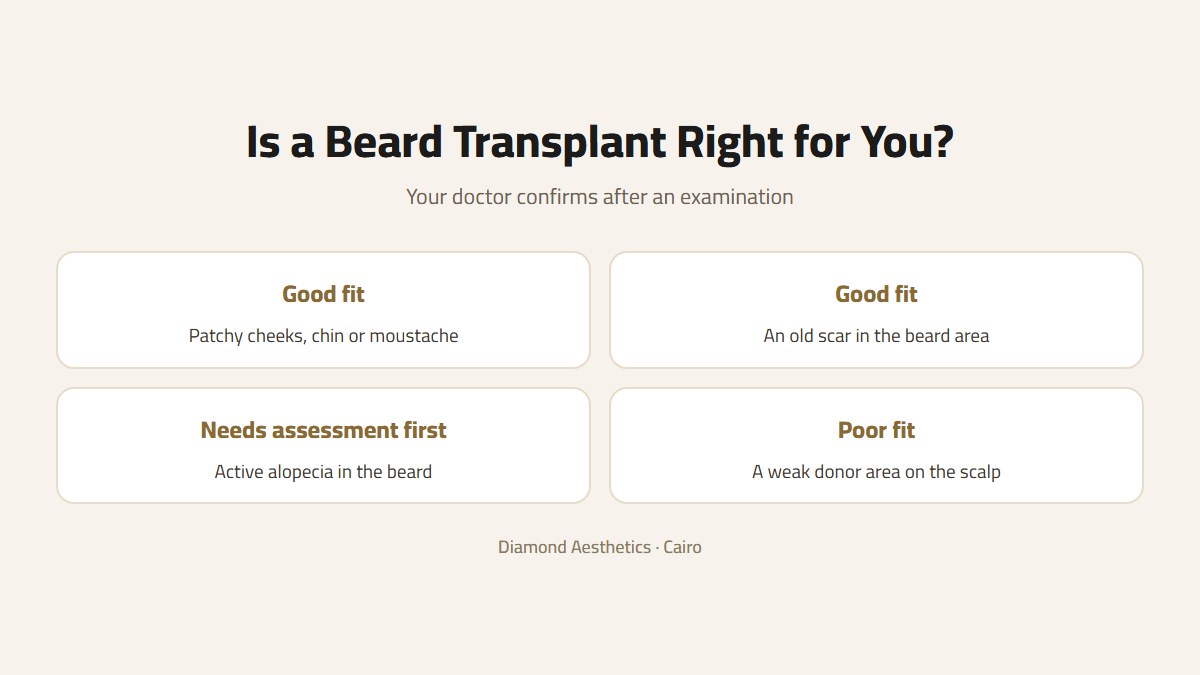
What matters most is the donor hair: its density, thickness and how close its colour is to your facial hair. It is a poor fit if your scalp is already thinning badly, because we would be borrowing from an area you may need later.
Patchy beard or alopecia?
Round, smooth patches that appear suddenly may be alopecia areata, which is a different condition. An active patch needs a medical assessment first, and transplanting into it is usually not the right step while it is still changing. We will tell you plainly if that is what we see.
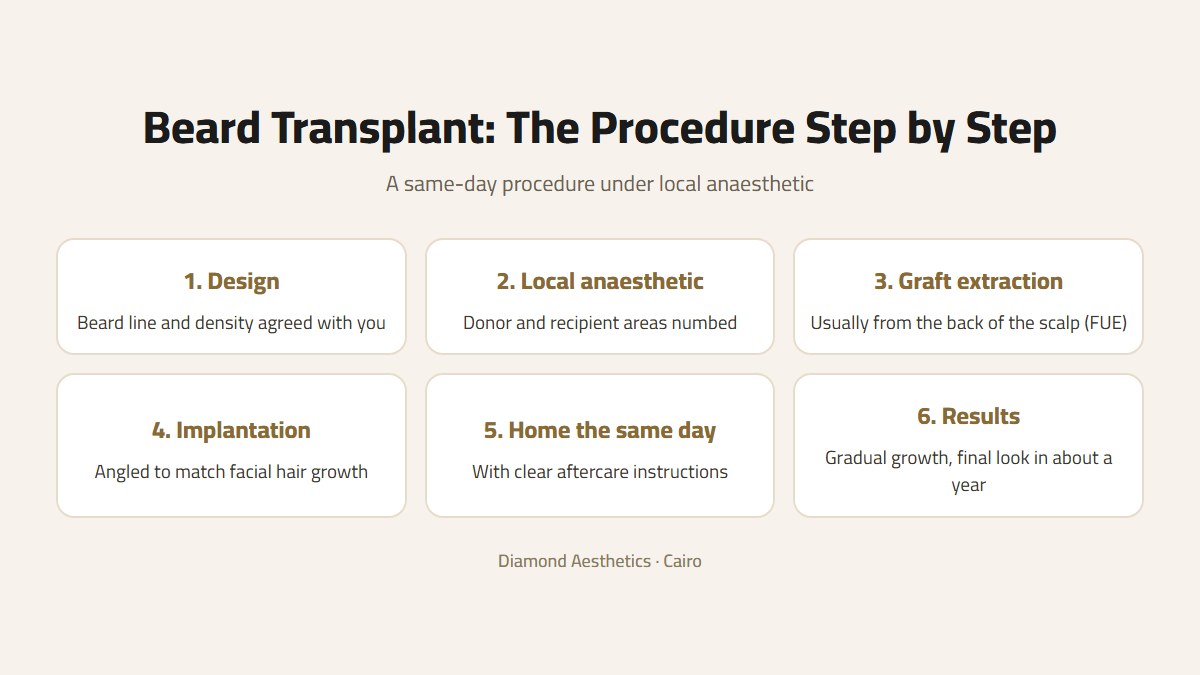
How a beard transplant is done, step by step
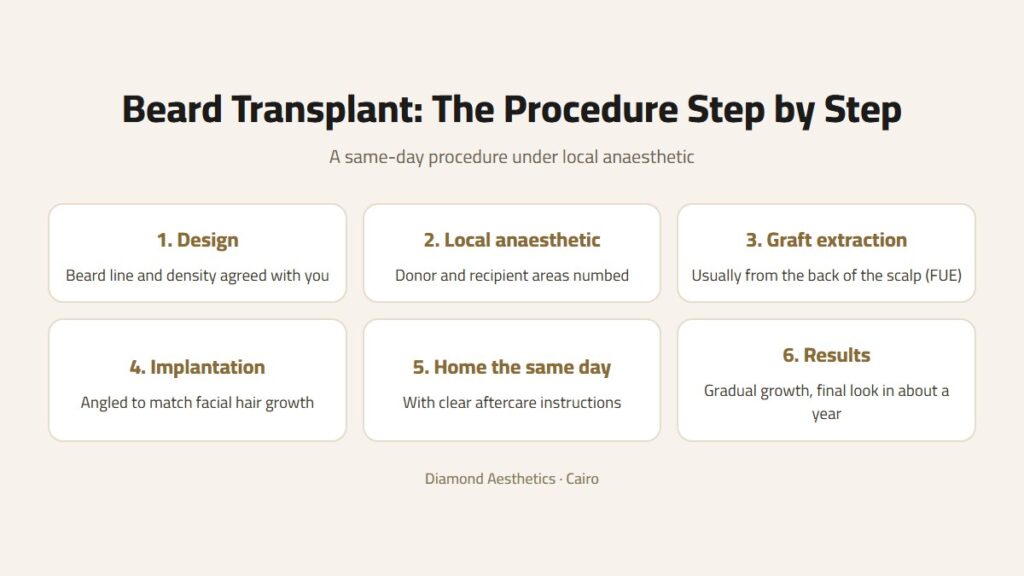
The day starts with design. Your surgeon draws the new beard on your face while you look in the mirror: where the cheek line sits, how low the neckline goes, how the moustache meets the chin. We take photos and measurements at this point.
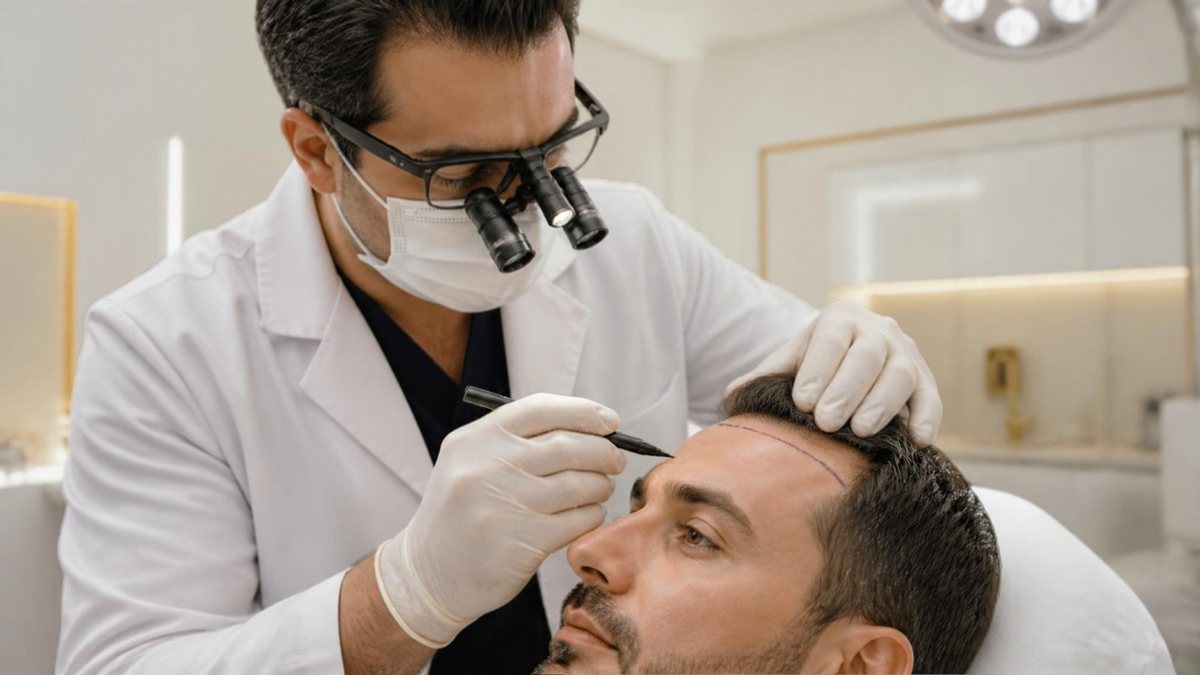
Both areas are then numbed. The injections sting for a minute or two; after that most patients feel pressure rather than pain, and many watch a film.
- Extraction: follicles are removed one by one, almost always with FUE.
- Sorting: single-hair grafts, which a natural beard needs, are separated from larger ones.
- Implantation: each graft goes in at a very low angle that follows your beard’s direction. This angle is what makes it look real.
- Check: the doctor reviews density and symmetry, and you get your aftercare instructions.
The session usually takes most of a working day. Our guide to FUE vs DHI hair transplant explains the extraction methods.
The donor area
For most men the donor area is the back and sides of the scalp. These hairs resist the hormone behind male pattern baldness, so they keep growing after they are moved. Scalp hair is often a little finer than beard hair, but once it settles among your own facial hair the difference is hard to spot.
Sometimes we use hair from under the chin, where the texture is closer. It gives fewer grafts, so it suits small touch-ups. Facial work at our hair transplant and restoration service follows the same standards as scalp procedures.
Moustache transplant
A moustache transplant is a smaller procedure, done alone or as part of a beard plan. The hairs on the upper lip point down and outwards from the middle, so placement has to be precise. A gap under the nose or a moustache that doesn’t reach the chin are the two problems we see most.
The lip swells a little more than the cheeks for two or three days. Soft food helps for a day. The growth timeline is the same as the rest of the beard.
Recovery after a beard transplant, day by day
The first week is more manageable than people expect. The face is red with small crusts around each graft, and swelling usually peaks around day two or three. Our hair transplant recovery timeline shows how healing behaves in general.
- Days 1 to 3: no washing the beard area, sleep with your head raised, don’t touch the grafts.
- Days 3 to 7: gentle washing as we show you, no gym or sauna.
- Days 7 to 10: most crusts fall off on their own.
- From about day 10: trimming with scissors or a trimmer.
- From about week 3 or 4: a razor, once your doctor confirms healing.
Most office workers go back after about a week. If a wedding is coming up next month, tell us so we can plan around it.
Beard transplant after 2 weeks and after 3 months
Between two and four weeks, many transplanted hairs fall out. It worries people, but the follicle stays under the skin and rests. A beard transplant after 2 weeks can look almost like before, apart from slightly pink skin.
A beard transplant after 3 months is where things change. Fine hairs appear, often one cheek before the other, then thicken and darken between months four and six. Final density is judged at around nine to twelve months.
Beard transplant before and after: what to expect
When people search for beard transplant before and after pictures, they want to know whether it looks natural. A good result looks like a beard you were born with: no straight edges, softer hairs at the cheek line, denser hairs along the jaw.
We take photos and measurements at your first session so you can compare honestly, and we never use borrowed photos. Expect better coverage, not the thickest beard in your family. Some men with large areas choose a second, smaller session later.
Is beard transplant safe, and is it permanent?
In experienced hands it is a minor procedure. Redness, crusts, mild swelling and a few ingrown-looking spots are expected, and infection is uncommon if you follow the aftercare. Our article on hair transplant side effects covers what is normal.
Are beard transplants permanent? The hairs keep the resistance of their original site, so once they grow they normally stay for life. You can shave and style them like the rest of your beard.
Why a failed beard transplant happens
A failed beard transplant is usually a design or technique problem: hairs at the wrong angle that stick out, grafts too large, a straight artificial cheek line, or an overharvested donor area. Our checklist for the best hair transplant doctor in Egypt applies equally to facial work.
Beard transplant cost and travelling to Cairo
The cost depends on the number of grafts, whether the moustache is included and how much design work your face needs. We confirm it after an assessment, which can start with photos. Our breakdown of hair transplant cost in Egypt explains the factors.
For UK and Gulf patients we suggest at least four or five days in Cairo: consultation, procedure, a next-day check and your first wash with us. Our guide for international patients covers flights, hotels and packing.
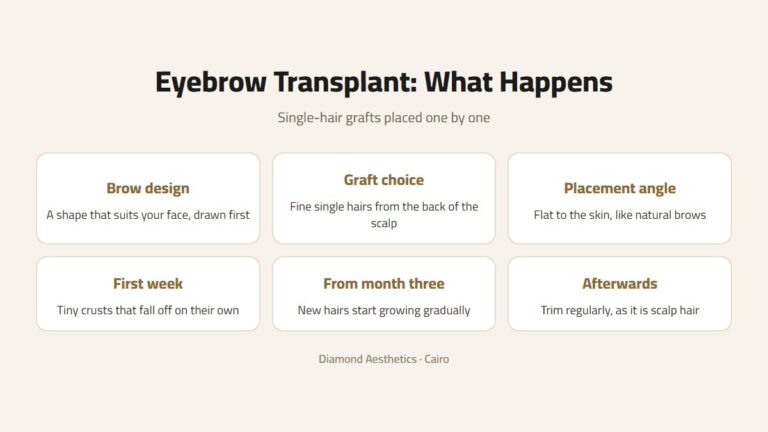
The same care with graft choice and angle goes into an eyebrow transplant, using finer single hairs.
What the experience is usually like
Most patients tell us the hardest part is the waiting. The journey usually goes: research and a video consultation, a long but calm procedure day, a week of looking red in photos, then the shedding phase when nothing seems to happen.
Around month four, the messages change. Men stop checking for gaps and start thinking about how to shape the beard. Some add PRP after hair transplant, though not everyone needs it.
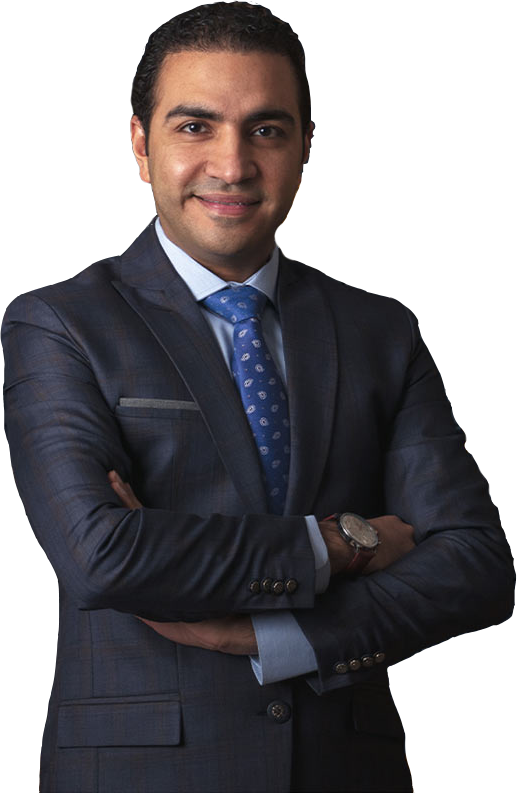
Your plan is supervised by Dr Sherif Hegazy, who has performed more than 10,000 procedures and is a member of ISHRS, ASPS and IAAM. The ISHRS also has a patient page on facial hair transplants.
Beard transplant in short: the procedure fills patchy cheeks, chin and moustache gaps and scars with your own follicles. It takes one day under local anaesthetic, a week of visible healing and nine to twelve months to the final, permanent result. Design and angle matter more than graft numbers.
FAQ
Beard transplant questions
Is beard transplant safe?
Yes, in experienced hands it is a minor procedure under local anaesthetic. Redness, small crusts and mild swelling for about a week are normal, and infection is uncommon if you follow the aftercare.
Are beard transplants permanent?
The transplanted hairs usually come from the back of the scalp, which resists balding, so once they grow they normally last for life and can be shaved and styled like the rest of your beard.
What does a beard transplant look like after 2 weeks?
Most crusts have gone and the skin is slightly pink. Many transplanted hairs shed between two and four weeks, which is expected, as the follicles stay under the skin.
What should I expect from a beard transplant after 3 months?
Fine new hairs usually appear around month three or four, often unevenly. They thicken over the following months, with the final look at around nine to twelve months.
Can I have a moustache transplant on its own?
Yes. A moustache transplant can be done alone or with the rest of the beard. The lip swells a little more for the first days, but the growth timeline is the same.
How much does a beard transplant cost in Egypt?
It depends on the number of grafts, whether the moustache is included and the design work needed. We confirm it after an assessment, which can start with photos before you travel.
Plan your beard transplant in Cairo
Send us a few clear photos of your face and the back of your head, and we will tell you honestly whether it makes sense for you or whether something else should come first. You can contact our team to book a consultation and plan your trip.
To see everything we offer for scalp and facial hair, visit our hair transplant and restoration page.